There are currently three major technical routes for power battery system integration: CTP (Cell to Pack, CATL),CTC (Cell to Chassis, Tesla), and CTB (Cell to Body, BYD).
This article is mainly focus on CTP, expecially for CTP 3.0
CATL CTP 1.0-4.0 Roadmap
| Technology Generation | Launch Year | Technical Architecture | Volume Utilization | System Energy Density | Fast Charging | Representative EV Models |
| CTM Cell to Module | / | Cell to Module to Pack. Modules have end plate and side plates | ¬45% | NCM: 150Wh/kg+ | – | – |
| CTP 1.0 | 2019 | Removed module side plates, replaced with binding bands; retained module structure. | ¬55% | NCM: 180Wh/kg+ | – | BAIC BJEV EU5 |
| CTP 2.0 | 2021 | Removed module end plates, replaced with enclosure beams; eliminated module level. | ¬60% | NCM: 200Wh/kg+ LFP: 160Wh/kg+ | 3C | NIO 75kWh, Avatr 11, Zeekr 001 |
| CTP 3.0 | 2022 | Removed cross/longitudinal beams, replaced with multi-functional elastic interlayers; eliminated all modules. | ¬72% | NCM: 255Wh/kg LFP: 160Wh/kg | 4C | Zeekr 009, Zeekr 001, Li MEGA, Xiaomi SU7, Lynk & Co |
| CTP 3.0+ | 2025 | Optimized interlayer design, enhanced cell expansion compensation capability. | ¬75% | NCM: 260Wh/kg LFP: 170Wh/kg | 5C | Xiaomi SU7 MAX, Zeekr 7X, IM L6, Geely LEVC L380 |
| CTP 4.0 | 2026 | Cells integrated directly into the chassis; traditional battery pack enclosure eliminated. | ¬80%+ | NCM: 280Wh/kg+ Na-ion (Sodium): 180Wh/kg+ | 6C+ | Not yet mass-produced |
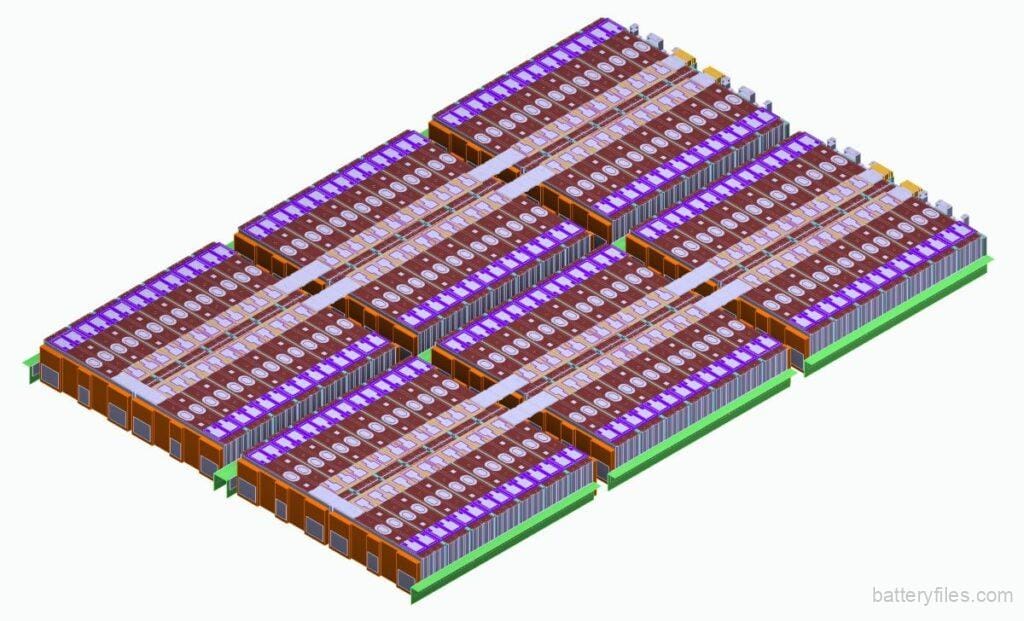
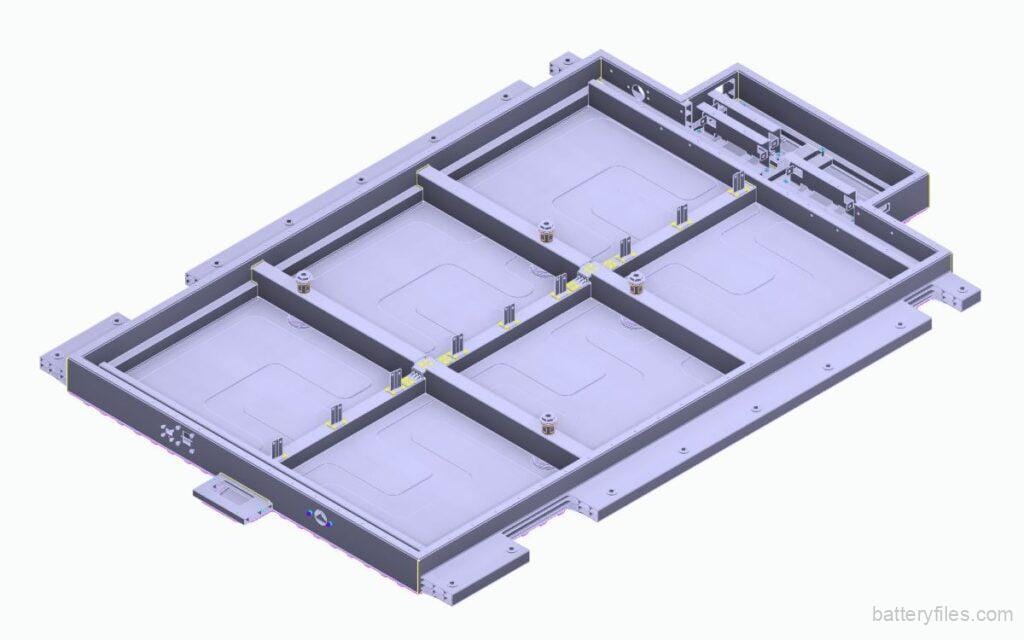
CTP 2.0(CALB NMC EV 614.88V 195Ah CTP 2.0 Battery)
Parallel Comparision CTP vs CTC vs CTB
CTP (Cell to Pack) Pioneered by CATL, its core idea is to eliminate the module level and integrate cells directly into the battery pack. It features a high level of integration, fewer components, and high production efficiency.
CTC (Cell to Chassis) Pioneered by Tesla, its core is to integrate battery cells directly onto the chassis while removing the outer housing of the battery pack. It boasts high integration and great structural rigidity, yet comes with high maintenance costs.
CTB (Cell to Body) Pioneered by BYD, its core concept is to combine the battery top cover and vehicle‑body floor into one, forming a “vehicle‑level sandwich” structure. Its technical highlight is that the battery pack serves as part of the vehicle‑body frame, delivering high structural rigidity.
Technology Comparision
| Comparison Dimension | CTP 3.0 (CATL Qilin Battery) | CTC (Tesla 4680 Battery) | CTB (BYD Seal Battery) |
|---|---|---|---|
| Integration Concept | Pack-level integration, module level eliminated. | Chassis-level integration, cells directly mounted to chassis crossmembers. | Body-level integration, battery pack top cover integrated with vehicle floor. |
| Structural Features | Multi-functional elastic interlayer (support + cooling + insulation + cushioning), cross/longitudinal beams eliminated. | Resin-filled structure, cells directly mounted to chassis. | Aluminum honeycomb sandwich structure, battery pack serves as body skeleton. |
| Safety | Liquid cooling plate provides additional insulation, achieving no thermal propagation. | Tabless design, low risk of thermal runaway. | Aluminum honeycomb structure disperses stress, good thermal runaway protection. |
| Maintainability | Removable battery pack, moderate maintenance cost. | High maintenance cost, usually requires full replacement. | Partially repairable, but requires full pack replacement after severe collisions. |
| Swapping Compatibility | Supported (Choco-SEB network) | Not supported | Not supported |
| Technology Led By | Battery Manufacturer | Automaker | Automaker |
| Advantages | High volume utilization, fewer parts, high production efficiency, excellent fast-charging performance. | High integration level, good structural rigidity, significant lightweighting. | High structural rigidity, significantly improved body torsional stiffness, good safety. |
| Disadvantages | Relatively lower structural rigidity, maintenance cost higher than traditional CTM(Cell to Module). | Extremely high maintenance cost, difficult production, complex battery-vehicle collaborative design. | No battery swapping, high maintenance cost, adaptable to fewer vehicle models. |
Performance Comparision
| Technical Parameter | CTP 3.0 (Qilin Battery) | CTP 2.0 | Traditional CTM(Cell to Module) Structure | Tesla CTC 4680 Battery | BYD CTB Blade Battery |
| Volume Utilization Rate | 72% | 60% | 40% | 63% | 66% |
| System Energy Density (NCM) | 255Wh/kg | 200Wh/kg | 180Wh/kg | 217Wh/kg | 200Wh/kg |
| System Energy Density (LFP) | 160Wh/kg | 200Wh/kg+ | 140Wh/kg | – | 200Wh/kg |
| Fast Charging Capability | 4C (10 mins to 80%) | 3C | 1-2C | 1C | 1C |
| Heat Exchange Area | 4x traditional design | 2x traditional design | Baseline | 2.5x traditional design | 1.5x traditional design |
| Cell Alignment Tolerance | ±0.3mm | ±0.5mm | ±1mm | ±0.8mm | ±0.4mm |
| Part Count | Reduced by 40% | Reduced by 30% | Baseline | Reduced by 25% | Reduced by 20% |
| Production Efficiency | Increased by 50% | Increased by 40% | Baseline | Increased by 35% | Increased by 30% |
| Cell Gap | < 1.5mm | 2-3mm | 3-5mm | 2.5mm | 2.2mm |
Representative CTP 3.0/CTP 3.0+ Vehicles
| Vehicle Model | Battery Pack Capacity (kWh) | Battery Pack Volume (m³) | Driving Range (km) | Fast Charging Time (10%-80%) | Battery Pack Weight (kg) | Gravimetric Energy Density (Wh/kg) | Volumetric Energy Density (Wh/L) |
|---|---|---|---|---|---|---|---|
| Zeekr 009 | 140 | 0.35 | 822 | 28 mins | 1,000 | 190 | 450 |
| Zeekr 001 | 100 | 0.24 | 715 | 28 mins | 750 | 200 | 450 |
| Li MEGA | 150 | 0.45 | 850 | 25 mins | 1,125 | 190 | 450 |
| Xiaomi SU7 Max | 101 | 0.26 | 800 | 19 mins | 750 | 200 | 450 |
| Geely LEVC L380 | 140 | 0.35 | 805 | 28 mins | 1,000 | 190 | 450 |